
I run into this problem all the time.
You serve multiple cities.
You want to rank for service + location.
You end up with dozens (or hundreds) of potential local landing pages.
And then the obvious question hits:
“How do I scale content for local landing pages without creating duplicate content or thin pages that won’t rank?”
Here’s the blunt truth:
Changing the city name in the URL and H1 is not a strategy.
It might work short-term. It will fail long-term.
Let me break down what actually works — and what doesn’t.
First: Let’s Kill the Duplicate Content Myth
Google does not “penalize” you for similar content.
What Google does is:
-
Ignore pages that add no new value
-
Choose one version to rank and suppress the rest
So yes — you can have similar pages.
No — you cannot have lazy, copy-paste location pages and expect consistent rankings.
Google explains this clearly here:
👉 https://developers.google.com/search/docs/fundamentals/creating-helpful-content
The rule is simple:
If two pages answer the same question in the same way, one of them is unnecessary.
The Core Principle: One Page = One Location + One Intent
Every local landing page must answer this exact question:
“Why should someone in this specific location choose you for this specific service?”
If your page could work just as well for another city by swapping the name, it’s weak.
That doesn’t mean reinventing your business story 50 times — it means local context, not local keywords.
How I Structure Local Landing Page Content at Scale
This is the framework I use when building local SEO pages that actually rank.
1. Start With a Fresh Page — Always
I never duplicate a base page and “rewrite it later.”
That’s how people accidentally create near-duplicates.
Instead, I:
-
Start with an empty document
-
Outline the page from scratch
-
Decide what’s unique about that location before writing
It’s slower upfront. It saves months of cleanup later.
2. Keep Services Consistent, Context Different
Your services don’t change by city — that’s fine.
What does change:
-
How people search
-
What they care about
-
The environment they live in
-
The problems they face
So instead of rewriting what you offer, rewrite:
-
How it applies locally
-
Why it matters in that city
-
What scenarios are common there
Same service. Different framing.
3. Use Local Proof — Even If You’re New
“No reviews in that city” is not an excuse.
You can still include:
-
Nearby service areas
-
Regional coverage explanations
-
Industry experience
-
City-specific examples or use cases
-
Local statistics or demographics (when relevant)
If you do have reviews, even better — tie them to the location using context or schema.
This improves trust and conversion, not just SEO.
4. Write Like a Blog Post, Not a Sales Page
This is where most people mess up.
High-performing local pages look more like helpful articles than aggressive landing pages.
That means:
-
Subheadings that answer real questions
-
Clear explanations
-
Natural internal links
-
No keyword stuffing
If your page reads like it was written “for SEO,” users bounce — and rankings follow.
5. Don’t Over-Split Keywords
If you offer:
-
Photography
-
Wedding photography
-
Event photography
You usually want:
-
One location page per service per city
-
Not everything crammed into one page
-
Not 10 pages fighting each other either
Relevance beats volume.
If a page tries to rank for everything, it ranks for nothing.
Scaling Local Pages Without Burning the Site Down
Here’s how I scale safely:
-
Shared structural template
-
Unique copy and examples
-
Different internal linking patterns
-
Location-specific FAQs
-
Local images where possible
-
Manual review before publishing
Yes, AI can help rewrite drafts — but only as a starting point.
If you publish raw AI output, you’re asking Google to ignore you.
Should You Create Local Pages Without Physical Offices?
This depends on the business model.
Service-area businesses, delivery services, marketplaces — yes, it works.
Fake office locations? No, that’s risky and unnecessary.
Google is surprisingly forgiving with local SEO — but don’t push into outright deception.
Moz covers this nuance well.
Final Reality Check
Local landing pages work extremely well when done right.
They fail when:
-
They’re mass-produced
-
They say nothing new
-
They exist only to manipulate keywords
If each page genuinely helps someone in that location make a decision, Google will reward it.
If it exists just to rank — it won’t.
That’s the line. Don’t cross it.
Related Posts
Case Study: Ranking a New Dental Clinic in Austin in 3 Months
Local SEO is one of the toughest digital marketing areas…
Is Local SEO Dead in 2026? (The Honest Truth)
Let me answer this straight: No — local SEO is…
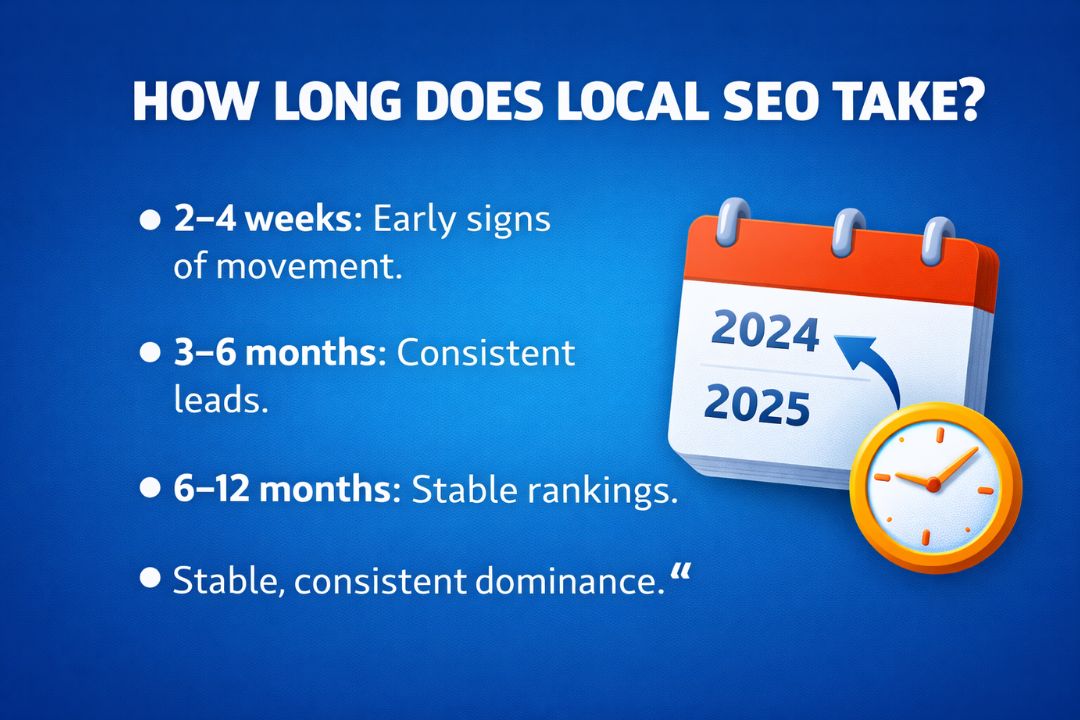
How Long Does Local SEO Take? (Real Timelines + What Actually Speeds It Up)
If you’re asking “how long does local SEO take?”, you’re…