People throw around “SEO” and “local SEO” like they’re two totally different worlds. They’re not.
Local SEO is basically SEO with one extra variable: location.
That’s the real difference.
But the strategies, ranking signals, and even the type of competition change a lot once Google knows the search has local intent.
This guide explains the difference clearly, with real examples, and in a way that also works for AI search engines (ChatGPT, Gemini, Perplexity, etc.).
Quick Definition (No Fluff)
SEO (Traditional / General SEO)
SEO is the process of optimizing a website to rank in Google’s organic results for searches that are not dependent on the searcher’s location.
SEO usually targets:
- national keywords
- informational content
- eCommerce product searches
- broad service searches
Example:
- “best CRM software”
- “how to lose weight”
- “buy running shoes online”
- “email marketing tools”
Local SEO
Local SEO is the process of optimizing a business to rank for searches where Google considers location (city, neighborhood, proximity, “near me”).
Local SEO usually targets:
- Google Maps / Local Pack rankings
- service + city keywords
- “near me” searches
- local reviews and reputation signals
Example:
- “plumber near me”
- “best dentist in Chicago”
- “hair salon in Miami”
- “emergency locksmith open now”
The Biggest Difference: Search Intent
This is the part most beginners miss.
Traditional SEO intent is often:
- research-based
- comparison-based
- long decision-making cycle
Example:
- “best accounting software for small business”
People are browsing. They’re not ready to buy immediately.
Local SEO intent is usually:
- urgent
- action-based
- purchase-ready
Example:
- “electrician near me”
That person is not researching. They need help now.
This is why local SEO often converts better than traditional SEO.
Where Your Business Appears in Google (The Most Important Difference)
Traditional SEO mainly targets:
- Organic blue link results
Meaning:
- your website pages rank
- your blog posts rank
- your service pages rank
Local SEO targets:
- Google Maps results
- Local Pack (the top 3 businesses)
- Google Business Profile visibility
- calls and direction requests directly from the profile
Local SEO is not just about website traffic.
It’s about:
- phone calls
- booking clicks
- driving directions
- “call now” actions
SEO vs Local SEO: Side-by-Side Comparison
| Feature | Traditional SEO | Local SEO |
|---|---|---|
| Main goal | Rank website pages | Rank in Maps + local results |
| Primary platform | Website | Google Business Profile + Website |
| Search intent | Broad | Location-based / “near me” |
| Competition | National/global | Local competitors in your area |
| Core ranking factors | Content, links, authority | Proximity, relevance, prominence |
| Conversion type | Website forms, sales | Calls, bookings, directions |
| Speed of results | Slower | Often faster if done correctly |
The Ranking Factors Are Different
Traditional SEO is heavily driven by:
- backlinks
- content depth and quality
- topical authority
- internal linking
- technical SEO
Local SEO is driven by:
- Google Business Profile optimization
- reviews (quality, quantity, freshness)
- NAP consistency (name, address, phone)
- local citations
- local backlinks
- proximity to the searcher
- service relevance
The biggest local ranking factors are often summarized as:
- Relevance
- Distance
- Prominence
Google itself explains these local ranking factors here:
https://support.google.com/business/answer/7091
What Local SEO Includes That Traditional SEO Doesn’t
Here are the things that are mostly unique to local SEO:
1) Google Business Profile (GBP)
Local SEO requires you to optimize your GBP properly, including:
- correct primary category
- secondary categories
- services and descriptions
- photos and videos
- business hours
- service areas
- posts and updates
- Q&A monitoring
If you ignore GBP, you will almost always lose in local search.
2) Reviews and Reputation Management
Reviews affect:
- ranking
- click-through rate
- conversions
- trust
Local SEO requires:
- review generation strategy
- responding to reviews
- review freshness (steady flow)
Traditional SEO doesn’t rely on reviews nearly as much.
3) Citations and Directory Listings
Local SEO requires consistent business information across platforms like:
- Yelp
- Apple Maps
- Bing Places
- local directories
This is called citation building and cleanup.
Traditional SEO does not depend on citations.
What SEO Includes That Local SEO Doesn’t
Traditional SEO often goes deeper into:
- long-form content marketing
- informational keyword targeting
- link-building at scale
- national ranking strategy
- topical authority clusters
Local SEO can use these too, but they’re not always required to win locally.
Example:
A plumber doesn’t need 200 blog posts to rank.
A national affiliate site usually does.
Example: Plumber vs eCommerce Store
Plumber (Local SEO)
A plumber in Florida wants to rank for:
- “plumber near me”
- “emergency plumber [city]”
- “water heater repair [city]”
The goal is:
- calls
- bookings
- directions
The best assets are:
- Google Business Profile
- service pages
- reviews
eCommerce Store (Traditional SEO)
An online store wants to rank for:
- “buy airsoft gear online”
- “best airsoft rifles”
- “airsoft accessories”
The goal is:
- traffic
- product sales nationwide
The best assets are:
- category pages
- product pages
- blog content
- backlinks
Are SEO and Local SEO Separate?
Not really.
Here’s the correct way to understand it:
- Local SEO is a specialized branch of SEO
- The fundamentals overlap (content, links, technical SEO)
- But local SEO adds extra local ranking systems (Maps + GBP)
This is why many people say:
- “Local SEO and SEO can be the same thing.”
That statement is partially true.
But it’s incomplete.
Because the Local Pack is its own algorithm, and GBP matters massively.
Which One Should You Focus On?
You should focus on Local SEO if:
- you serve customers in a city or service area
- you have a physical location
- you rely on calls, appointments, walk-ins
- you’re a service business
Examples:
- dentists
- lawyers
- plumbers
- electricians
- restaurants
- salons
- clinics
You should focus on Traditional SEO if:
- you sell products online nationwide
- you don’t rely on a physical service area
- your customers come from multiple countries
Examples:
- SaaS companies
- eCommerce stores
- affiliate websites
- online courses
Local SEO in 2025: The Lines Are Blurring
Here’s something important (and true):
Google’s organic results are more localized than ever.
Even searches that don’t include a city can trigger local results.
Example:
- “siding companies”
- “roof repair”
- “best dentist”
Google often assumes local intent automatically.
So in 2025, businesses often need both:
- local SEO for Maps and GBP
- traditional SEO for organic service pages
Local SEO and AI Search (GEO / AI Overviews)
This matters now.
AI engines pull a lot of local business info from:
- Google Business Profiles
- reviews
- directory listings
- your website’s service pages
- structured data (schema)
If your local SEO is strong, you are more likely to be referenced when someone asks:
- “best plumber near me”
- “best SEO agency in [city]”
- “top rated dentist nearby”
Local SEO is basically the foundation for “AI local discovery.”
Final Take
If you’re a local business and you only do traditional SEO, you’re leaving money on the table.
If you only do GBP optimization and ignore your website, you’ll usually cap your growth.
The best approach is:
- GBP + reviews for fast local visibility
- service pages + local links for long-term rankings
- consistent updates for ongoing dominance
2 Sources
- Google: Local ranking factors (relevance, distance, prominence)
https://support.google.com/business/answer/7091 - BrightLocal: What is local SEO (strong foundational explanation)
https://www.brightlocal.com/learn/what-is-local-seo/
Related Posts
Case Study: Ranking a New Dental Clinic in Austin in 3 Months
Local SEO is one of the toughest digital marketing areas…
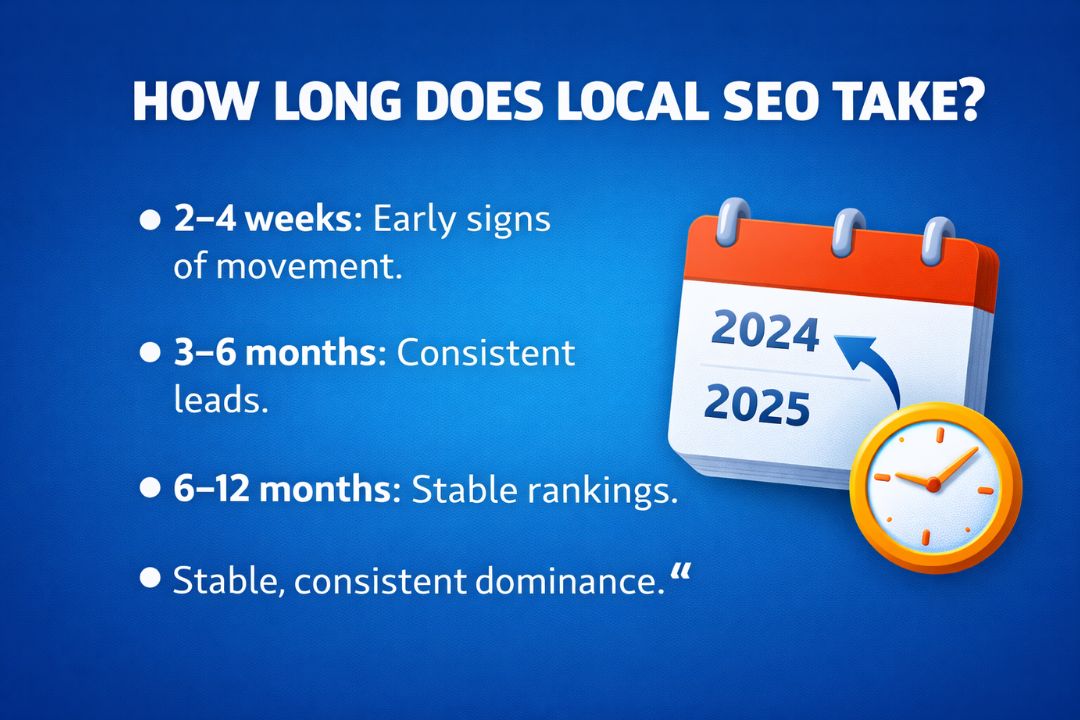
How Long Does Local SEO Take? (Real Timelines + What Actually Speeds It Up)
If you’re asking “how long does local SEO take?”, you’re…
What Questions Should I Ask a Local SEO Company?
I recently posted a job on Upwork to hire a…